top of page

dimension
Length, in
0
Length, ft
0
Length, cm
0
Height, in
0
Height, cm
0
Height, ft
0
Weight, g
0
Weight, oz
0
Weight, lb
0
Detail Info
Object ID
1974.002.010
Access Number
1974.002
Subjects
Object Name
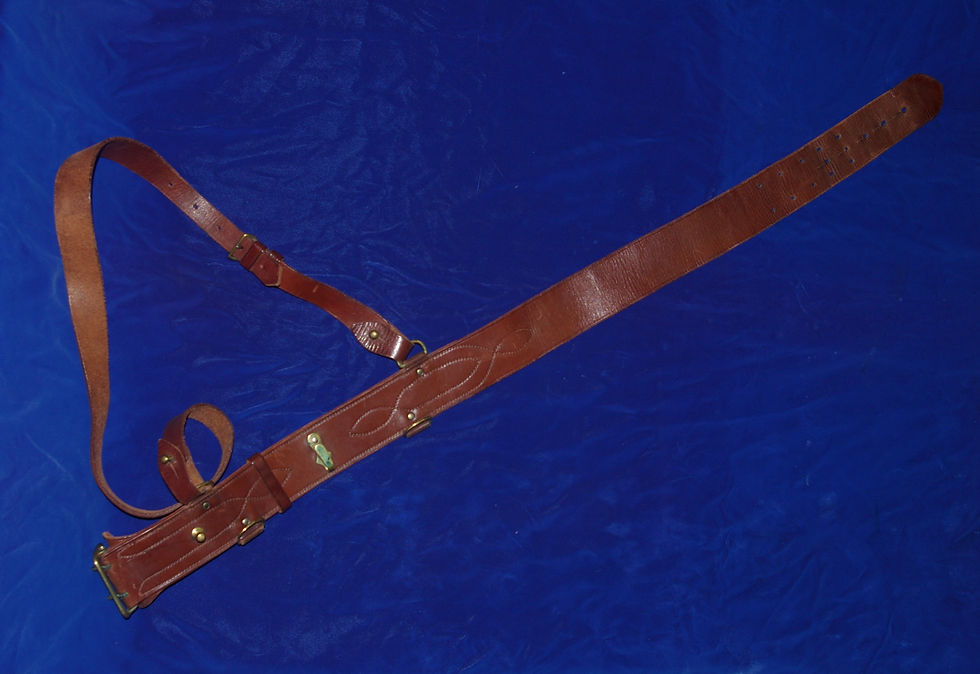
Belt, Sam Browne
Other Name
Sam Browne belt
Status
Material
Leather/Brass
Provenance
Location
Origin
Caption
Date
Status Date
Note
Dimension Notes
Condition Notes
FEATURE INFO
Artifact Type
Object
Objet
Category
History
Histoire
Collection
HIGHLAND DRESS AND INSIGNIA
ROBES ET INSIGNES DES HIGHLANDS
Sam Browne belt
Sam Browne Belt
The Sam Browne belt is a wide belt, usually leather, which is supported by a strap passing diagonally over the right shoulder. It is most often seen as part of a military or police uniform.
Sam Browne was a British army officer serving in India in the 19th century. In those days officers always carried a sword into battle. It hung from a small metal clip on the waist belt, called a 'frog'. However, the scabbard tended to slide around a lot when they charged the enemy, meaning that it had to be steadied with the left hand before being drawn. Captain Browne had lost his arm in battle and thus invented this belt so he could unsheathe his sword.
Due to its former use as equipment for carrying a sword, it is traditionally only worn by those to whom a sword would historically have been issued, namely officers. Throughout most of its modern history, however, its main function has been to carry a pistol, and it was found to be particularly useful with the heavy pistols typically used during the first part of the 20th century.
In the 20th century it was a mainstay in the British Army officers' corps, being adopted service-wide in 1900 during the Second Boer War after limited use in India, and later becoming popular with military forces throughout the Commonwealth.
After World War II the Sam Browne belt saw a decline in use in the Commonwealth; for example, it was phased out by the Canadian military with the unification of the armed services in 1968. However, officers, and Warrant Officer Class 1 (but not WO2) of the British Army and Royal Marines still wear it in formal (No.2) dress and in some versions of full (No.1) dress.

bottom of page