top of page

dimension
Length, in
Length, ft
Length, cm
Height, in
Height, cm
Height, ft
Weight, g
Weight, oz
Weight, lb
Detail Info
Object ID
1985.015.002.010
Access Number
1985.015
Subjects
Object Name
Photograph, Black & White
Other Name
Status
Material
Provenance
Location
Origin
Caption
Date
Status Date
Note
Dimension Notes
Album: 5.75" x 4.75"
Condition Notes
FEATURE INFO
Artifact Type
Image
Image
Category
Collection
FOUNDATIONS OF THE 72nd REGIMENT, 1910-1914
Fondation du 72e régiment, 1910-1914
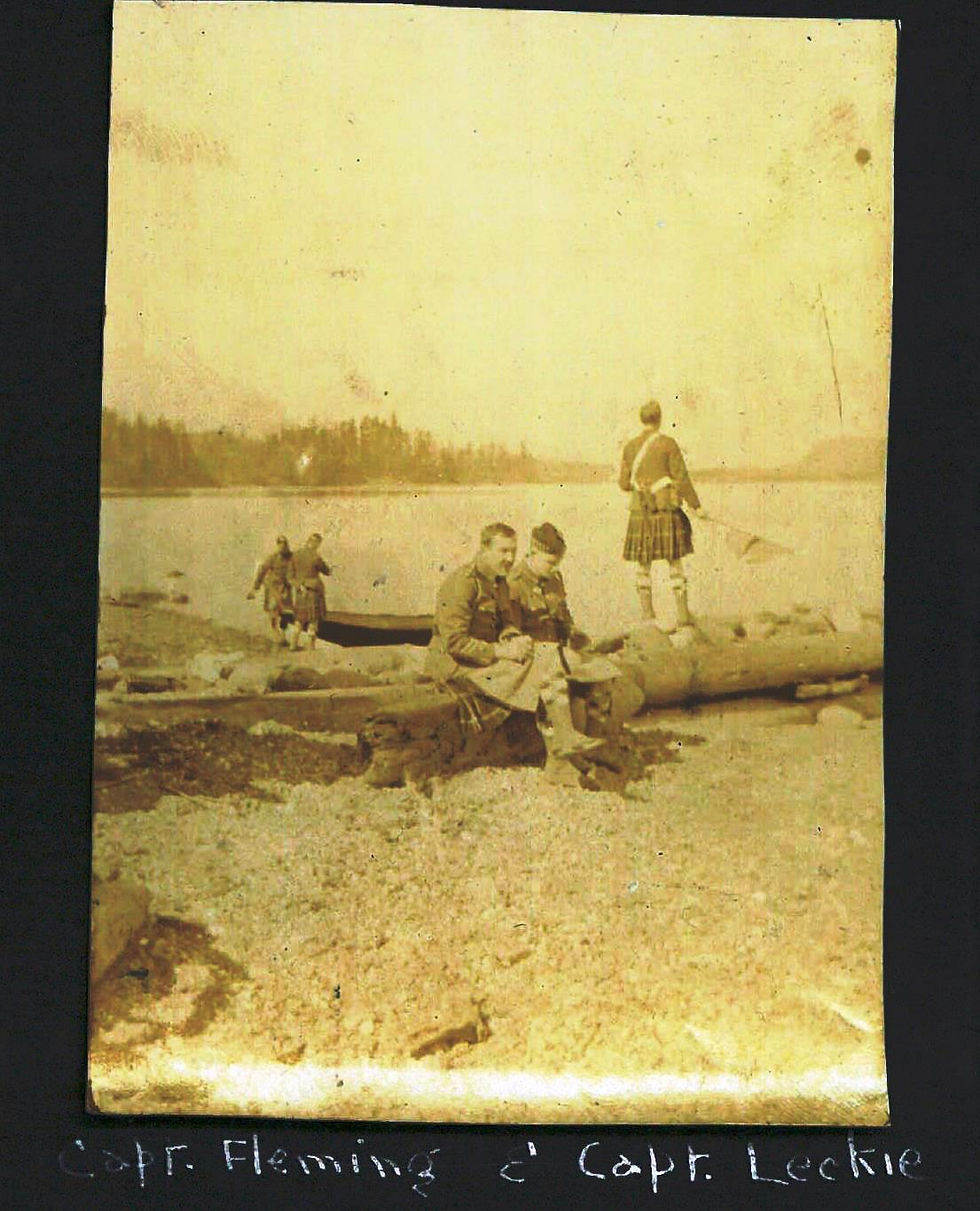
Capt. Fleming and Capt. Leckie on beach, Vancouver Island, 1913
72nd Regiment, Seaforth Highlanders of Canada engaged in Aid to Civil Powers for the Coal Miners' Strike on Vancouver Island, Nanaimo,1913 - 1914.
Caption: "Capt. Fleming and Capt. Leckie" written white in pen underneath the photo on the page.
Captain John Edwards "Jack" Leckie, DSO and Captain Hamilton Maxwell Fleming reading charts/orders while sitting on log on a beach on Vancouver Island during the coal miner's strike. There are three Seaforths in the background and two of them are at a boat.
At the onset of the Great War, 72nd Regiment Captain Hamilton Maxwell Fleming [Flemming] enlisted as the 2nd in Command of No. 2nd Company, 16th Battalion, Canadian Scottish on 22 September 1914 . He arrived in France on 9 February 1915, He was killed in action on 15 April, 1915. Hamilton Maxwell Fleming, #6191 also served in the South African (Boer) War with the 2nd Regiment, Brabant's Horse and ended as a Quartermaster Sergeant (CQMS).
The Vancouver Island Coal Strike began on 16 Sept. 1912 when miners at Cumberland declared a "holiday" to protest the firing of Oscar Mottishaw. Canadian Collieries locked them out and hired Chinese and strike breakers. The issues were safety (gas explosions had killed hundreds) and union recognition. Other employers followed the pattern in resisting any union. By spring 1913, 3,500 miners from Vancouver Island were off work with the United Mine Workers of America providing leadership and strike pay.
In the summer of 1912, the Vancouver and Nanaimo Coal Co., settled with its employees, but not before rioting, arsons and "shoot-outs" had broken out in all the coal towns. Peace was restored when the BC government sent in 1,000 militiamen. The withdrawal of strike pay in the summer of 1914 and the beginning of WW I ended the confrontation. By then the mines were running at almost pre-strike capacity using newly hired labour.

bottom of page