top of page

dimension
Length, in
Length, ft
Length, cm
Height, in
Height, cm
Height, ft
Weight, g
Weight, oz
Weight, lb
Detail Info
Object ID
1985.015.002.042
Access Number
1985.015
Subjects
Object Name
Photograph, Black & White
Other Name
Status
Material
Provenance
Location
Origin
Caption
Date
Status Date
Note
Dimension Notes
Album: 5.75" x 4.75"
Condition Notes
FEATURE INFO
Artifact Type
Image
Image
Category
Collection
FOUNDATIONS OF THE 72nd REGIMENT, 1910-1914
Fondation du 72e régiment, 1910-1914
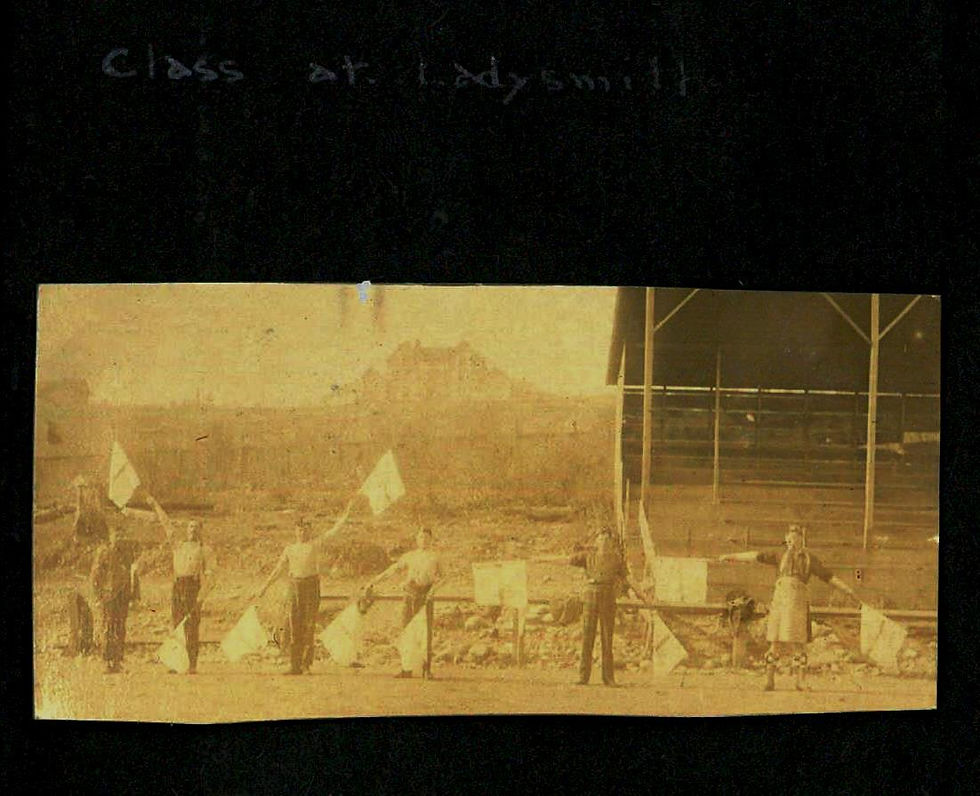
Signal Section flag semaphore class, Ladysmith during Miner's Strike, 1913
72nd Regiment, Seaforth Highlanders of Canada engaged in Aid to Civil Powers for the Coal Miners' Strike on Vancouver Island, Nanaimo,1913 - 1914.
The Seaforth Highlanders of Canada Signals Section flag semaphore training at the sports field at Ladysmith, BC. To the right are the bleachers and to the left, houses. The same men as in photo 1985.015.002.041.
Flag semaphore is the telegraphy system conveying information at a distance by means of visual signals with hand-held flags, rods, disks, paddles, or occasionally bare or gloved hands. Information is encoded by the position of the flags; it is read when the flag is in a fixed position. The current flag semaphore system uses two short poles with square flags, which a signalman holds in different positions to signal letters of the alphabet and numbers. The signalman holds one pole in each hand, and extends each arm in one of eight possible directions. Except for in the rest position, the flags do not overlap. The flags are colored differently based on whether the signals are sent by sea or by land. At sea, the flags are colored red and yellow (the Oscar flag), while on land, they are white and blue (the Papa flag). Flags are not required; their purpose is to make the characters more obvious.
The Vancouver Island Coal Strike began on 16 Sept. 1912 when miners at Cumberland declared a "holiday" to protest the firing of Oscar Mottishaw. Canadian Collieries locked them out and hired Chinese and strike breakers. The issues were safety (gas explosions had killed hundreds) and union recognition. Other employers followed the pattern in resisting any union. By spring 1913, 3,500 miners from Vancouver Island were off work with the United Mine Workers of America providing leadership and strike pay.
In the summer of 1912, the Vancouver and Nanaimo Coal Co., settled with its employees, but not before rioting, arsons and "shoot-outs" had broken out in all the coal towns. Peace was restored when the BC government sent in 1,000 militiamen. The withdrawal of strike pay in the summer of 1914 and the beginning of WW I ended the confrontation. By then the mines were running at almost pre-strike capacity using newly hired labour.

bottom of page