top of page

dimension
Length, in
Length, ft
Length, cm
Height, in
Height, cm
Height, ft
Weight, g
Weight, oz
Weight, lb
Detail Info
Object ID
1985.015.002.116
Access Number
1985.015
Subjects
Object Name
Photograph, Black & White
Other Name
Status
Material
Provenance
Location
Origin
Caption
Date
Status Date
Note
Dimension Notes
Album: 5.75" x 4.75"
Condition Notes
FEATURE INFO
Artifact Type
Image
Image
Category
Collection
FOUNDATIONS OF THE 72nd REGIMENT, 1910-1914
Fondation du 72e régiment, 1910-1914
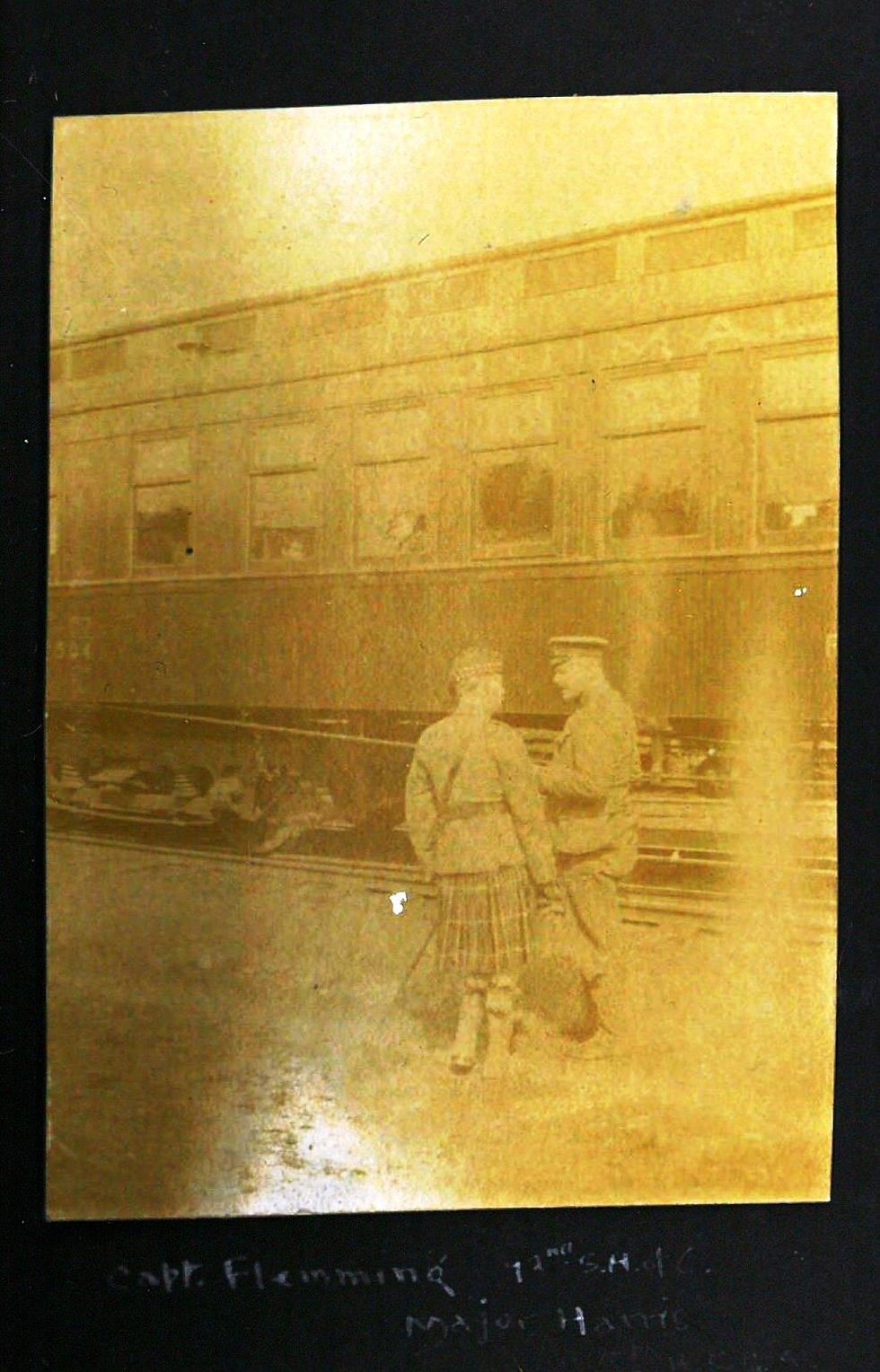
Capt. Flemming, 72nd Regt & Maj Harrison, 88th Regt by E & N railcar. 1913-14
72nd Regiment, Seaforth Highlanders of Canada engaged in Aid to Civil Powers for the Coal Miners' Strike on Vancouver Island, Nanaimo,1913 - 1914.
Caption on page: "Capt. Fleming, 72nd S.H. of C. / Major Harris" [sic Harrison]
Capt. Flemming [Fleming], 72nd Regiment and Major Benjamin Hutchison Harrison, 88th Victoria Fusiliers beside an Esquimalt & Nanaimo Railway car.
Captain Hamilton Maxwell Fleming [Flemming] enlisted as the 2nd in Command of No. 2nd Company, 16th Battalion, Canadian Scottish on 22 September 1914 from the 72nd Regiment. He arrived in France on 9 February 1915, He was killed in action on 15 April, 1915.
Hamilton Maxwell Fleming, #6191 also served in the South African (Boer) War with the 2nd Regiment, Brabant's Horse and ended as a Quartermaster Sergeant (CQMS). On 5 November 1899, Edward Brabant raised the Light Horse Regiment known as Brabant's Horse. The top strength of the unit was 600, all ranks, including South African colonials, Australians, British, Canadians. The unit saw much action against Boer commandos. Brabant's Horse was disbanded in Cape Town on 31 December 1901.
Benjamin Hutchison Harrison was born in Thorner, Yorkshire, England on 31 July, 1883. He was educated at the Magnus Grammar School at Newark-on-Trent, England. Harrison started his business career at Messrs. Samuel Smith & Co. in 1900. He joined the 3rd Volunteer Battalion, The Northamptonshire Regiment. In 1901 he volunteered for the South African War. After seeing active service, he joined the Cape Mounted Riflemen in South Africa. In 1906, Harrison emigrated to Canada and became a rancher. In 1911 he received a commission in the newly formed 88th Regiment, Victoria Fusiliers. When the 88th Battalion, CEF was formed, he became the 2 i/c. Harrison reverted to the rank of Captain to serve in England and France with the 88th Battalion, 30th Reserve Battalion, 1st Reserve Battalion, Canadian School of Musketry, Shornecliffe, England and Canadian Corps Reinforcement Camp.
The Equimalt and Nanaimo Railway (E&N) was formed in 1883 as part of the treaty made by Prime Minister John A. Macdonald to bring British Columbia into Confederation. Although the railway was 10 years overdue, Macdonald kept his word and was on hand to drive the last spike in 1886.
This railway was not part of the new Canadian Pacific Railway (CPR). Traffic was projected to be low and consequently this section was not of high priority to the CPR, which was severely cash strapped at the time. Eventually the contract was awarded to Robert Dunsmuir, a coal baron and politician in the provincial government.
Dunsmuir was likely more interested in the land grants than the railway. The grants were generous and amounted to 10 per cent of Vancouver Island along with mineral rights and all known coal deposits. The railway was completed in 1886 with two further extensions in 1887 and 1888, when it was extended to Victoria.
Following Dunsmuir's death in 1889, his empire was taken over by his son James. The railway was sold to the CPR in 1905. Apart from passenger service which was turned over to VIA Rail in 1978, the CPR continued operating the railway until 1999. In 1998 they sold the route from Nanaimo to Port Alberni to RailAmerica, who also leased the remainder of the railway.
The Vancouver Island Coal Strike began on 16 Sept. 1912 when miners at Cumberland declared a "holiday" to protest the firing of Oscar Mottishaw. Canadian Collieries locked them out and hired Chinese and strike breakers. The issues were safety (gas explosions had killed hundreds) and union recognition. Other employers followed the pattern in resisting any union. By spring 1913, 3,500 miners from Vancouver Island were off work with the United Mine Workers of America providing leadership and strike pay.
In the summer of 1912, the Vancouver and Nanaimo Coal Co., settled with its employees, but not before rioting, arsons and "shoot-outs" had broken out in all the coal towns. Peace was restored when the BC government sent in 1,000 militiamen. The withdrawal of strike pay in the summer of 1914 and the beginning of WW I ended the confrontation. By then the mines were running at almost pre-strike capacity using newly hired labour.

bottom of page