top of page

dimension
Length, in
Length, ft
Length, cm
Height, in
Height, cm
Height, ft
Weight, g
Weight, oz
Weight, lb
Detail Info
Object ID
1985.015.002.143
Access Number
1985.015
Subjects
Object Name
Photograph, Black & White
Other Name
Status
Material
Provenance
Location
Origin
Caption
Date
Status Date
Note
Dimension Notes
Album: 5.75" x 4.75"
Condition Notes
FEATURE INFO
Artifact Type
Image
Image
Category
Collection
FOUNDATIONS OF THE 72nd REGIMENT, 1910-1914
Fondation du 72e régiment, 1910-1914
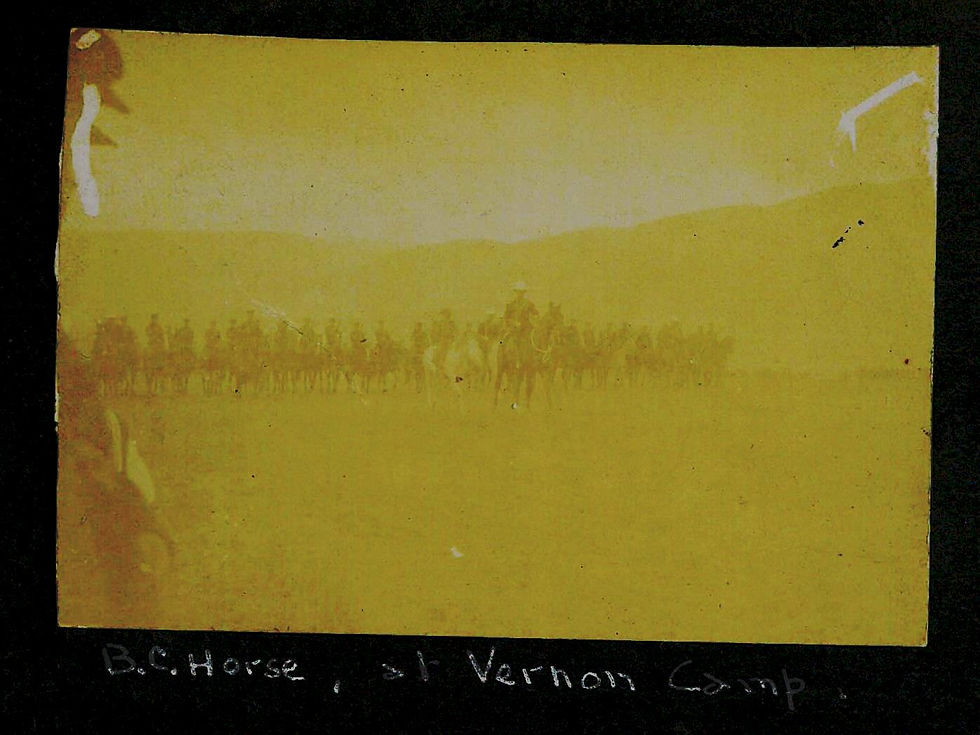
A squadron of the BC Horse at Camp Vernon, 1911-1914
A squadron/troop of the British Columbia Horse marching in line during a parade or review at Camp Vernon, 1913
Caption on photo: "BC Horse Camp Vernon"
From the Regimental History, page 11:
"At the end of May, 1913, the Seaforths joined other regiments at the training camp at Vernon, B. C. This was said to be the largest military camp held in the province up to that time, there being about 1500 men present, including cavalry. Colonel Roy, D. O. S., was the inspecting officer, and some very good work was done."
From The Greater Vernon Museum & Archives website (https://vernonmuseum.ca/ex_dragoons.html): In April 1908, an independent squadron known as the Canadian Mounted Rifles (unofficially the Okanagan Mounted Rifles) was authorized for Vernon. This unit went to camp for the first time in 1908 under the command of Major H.A. Perry, D.C.M., a veteran of the Boer War. Later, in December 1911, the unit was granted authority to change its name from the Canadian Mounted Rifles to the 1st Regiment, B.C. Horse. In 1912, the B.C. Horse became the 30th Regiment, B.C. Horse. The regiment, with headquarters in Vernon, consisted of "A" Squadron from Lumby and Coldstream, "B" Squadron from Vernon, "C" Squadron from Armstrong and Enderby, and "D" squadron from Kelowna.
In his annual report to Ottawa, District Officer Commanding Colonel R.L. Wadmore stated: "I consider
all squadrons of the B.C. Horse much superior to the average Eastern cavalry as these men can ride
These mounted units in B.C. are therefore a distinctly valuable asset to the Defence Force of Canada."
In 1912, the same year the 30th B.C. Horse came into being, a permanent annual district summer training camp for cavalry and infantry militia units was established in Vernon on Mission Hill.
The camp that took place in Vernon during the first two weeks of June 1913 attracted about 800 soldiers. In addition to the 30th B.C. Horse taking part, there was also the 31st B.C. Horse (headquartered in Merritt), the Army Service Corps from Vancouver, the 102nd Regiment of Infantry [New Westminster], Royal Canadian Garrison Artillery, the Rocky Mountain Rangers, and other militia units [including the 72nd Regiment]. Four boxcar loads of equipment and supplies weighing in at over 60 tons were shipped to the camp from Victoria.
The population of Vernon at this time was barely 3,000 individuals. Needless to say, the presence of hundreds of military men had a profound economic and social impact on the town. Concerts were often given by various regimental bands in the evenings at City Park and, at the end of the two-week training session, spectators from throughout the region would come to Vernon to see ceremonial parades and a "military sports day" held at the camp. Regiments would compete in tug-of-war matches, horse racing, obstacle races, horseback wrestling, and tent pegging.

bottom of page