top of page

dimension
Length, in
0
Length, ft
0
Length, cm
0
Height, in
0
Height, cm
0
Height, ft
0
Weight, g
0
Weight, oz
0
Weight, lb
0
Detail Info
Object ID
1998.123.033
Access Number
1998.123
Subjects
Object Name
Compass
Other Name
German WW II Prismatic Compass
Status
Material
Metal/Plastic
Provenance
Location
Origin
Caption
Date
Status Date
Note
Dimension Notes
Condition Notes
FEATURE INFO
Artifact Type
Object
Objet
Category
History
Histoire
Collection
FIELD EQUIPMENT
ÉQUIPEMENT DE TERRAIN
German WW II Wrist Compass with wrist strap
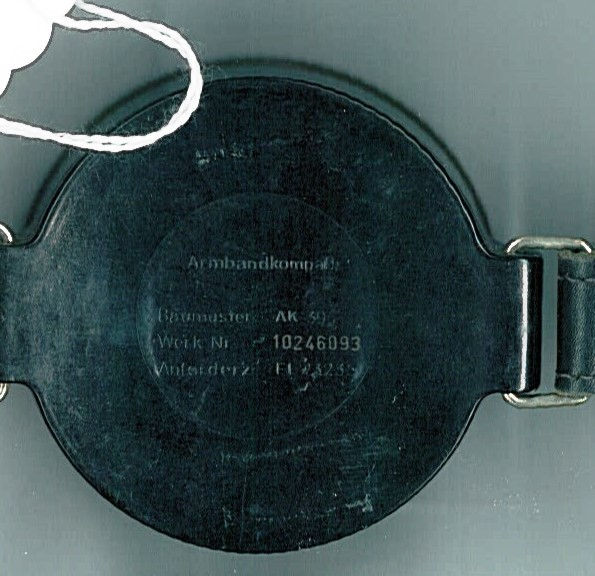
German WW II Luftwaffe airman's wrist compass, model AK 39. Prismatic Compass with wrist band. The text on the back reads: "Armbandkompaß [Armbandkompass] Baumuster AK 39 Werk Nr. 10246093 Anfertderz F1 23235 [ Anforderungszeichen (Procurement no.): Fl 23235]. The letters Fl are the abbreviation for Fliegermaterial [aeronautical materiel]. It has a bakelite case with a painted transparent bezel, with most of its paint remaining. The Werk Nr. is the only unique marking and is likely the serial number, and it's lower than most. Although the compass has a bubble in it, it stills works.
Model AK 39 / LK 10
There were two versions of the AK 39 compass: a simple black one and a white one with sighting aids. The abbreviation AK means Armband-Kompass (wrist compass) and the figure 39 probably the design year: 1939. The abbreviation LK probably means Luftfahrer-Kompass (aviator's compass) and the figure 10 could be the manufacturers's's catalogue reference. Since there were other aeronautical compasses, this designation was adapted to the official Luftwaffe wording: like FK for Führer-Kompass (pilot's compass) or OK for Orterkompass (observer/navigator compass).
They were utilized by German pilots during WW II. The black model (procurement no. Fl 23235 featured only a lubber's line (that used to be luminous). The white model (Fl 23235-1) allowed the setting of a course by means of two white rotating semi-circular sheets located at the underside. Moreover, rifle-type sighting aids allowed the taking of a bearing (on the ground if downed).


bottom of page