top of page

dimension
Length, in
0
Length, ft
0
Length, cm
0
Height, in
0
Height, cm
0
Height, ft
0
Weight, g
0
Weight, oz
0
Weight, lb
0
Detail Info
Object ID
1998.130.024
Access Number
1998.130
Subjects
Object Name
Badge, Cap
Other Name
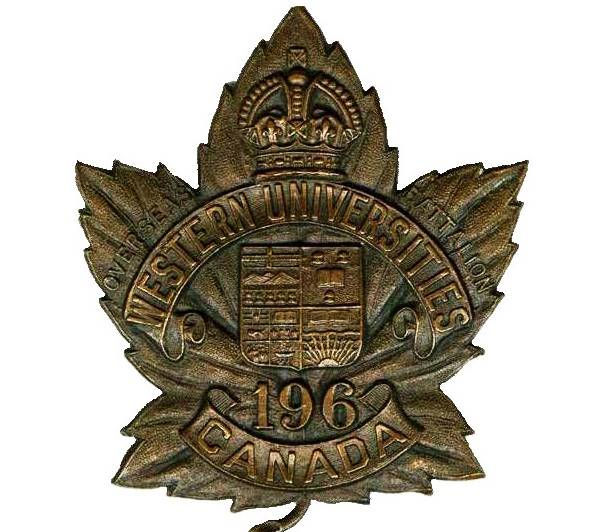
Cap Badge - 196th (Western Univ.) Bn CEF
Status
Material
Copper
Provenance
Location
Origin
Caption
Date
Status Date
Note
Dimension Notes
Condition Notes
FEATURE INFO
Artifact Type
Object
Objet
Category
History
Histoire
Collection
BADGES
BADGES
Cap Badge - 196th (Western Universities) Battalion, CEF
Cap Badge - 196th (Western University, London) Battalion, CEF
The 196th (Western Universities) Battalion, CEF was a unit in the Canadian Expeditionary Force during the First World War. Based in Winnipeg, Manitoba, the unit began recruiting during the winter of 1915/16 in universities throughout Western Canada. After sailing to England in November 1916, the battalion was absorbed into the 19th Reserve Battalion on January 2, 1917.
The 196th (Western Universities) Battalion was formed during World War I, primarily from students who were enrolled in the universities of western Canada. The idea for the unit began in February 1916, when students from the universities of Manitoba, Saskatchewan, Alberta and British Columbia, wanting to maintain their university identity, lobbied the Minister of Militia and convinced him to authorize the formation of a western university battalion. Each university was to raise a company of about 250 men. Captain Reginald Bateman, the University of Saskatchewans first Professor of English, who was serving in France with the 28th (Northwest) Battalion, CEF, was brought back to Canada to command the Saskatchewan Company. The men received their preliminary training at the then-new university residence, QuAppelle Hall, and the company joined the other university companies at Camp Hughes in Manitoba, where the battalion was being formed. The Western Universities Battalion expected to serve in France as a formed unit; however, when the battalion was sent to England it was broken up and dispersed as reinforcements to other units.
Recruitment of university students in Saskatchewan had begun almost immediately upon war being declared in 1914. The next appeal for enlistment made to university faculty and students came in September 1914 from the 28th Battalion, then recruiting in Regina. A number of professors, including Professors Bateman and Brehaut, and a group of their students, left their classrooms to join the battalion on November 1, 1914. The next call to University of Saskatchewan students to enlist came from McGill University in Montreal, where platoons of university students were being organized as part of the 58th Battalion, CEF. The University of Saskatchewans contribution was to be two platoons, each consisting of a non-commissioned officer and sixteen other ranks. These university platoons were later to become reinforcements for the Princess Patricias Canadian Light Infantry, then serving overseas in France as a unit of the British army.
The final group of University of Saskatchewan students to be enlisted was the Duval draft of March 1917. Edward Duval, superintendent of the Civilian Personnel Regionalizations Saskatoon division, recruited about fifty men, including twelve undergraduates, to train in the QuAppelle Hall offices formally used by the Western Universities Battalion. They were sent to France in mid-summer 1917 to serve as reinforcements. When the Borden government instituted conscription in May 17, 1917, forty-six University of Saskatchewan students were accepted into the air force and several others were enrolled into the University of Saskatchewan company of the Canadian Officers Training Corps.
The Battalion Chaplain was the distinguished theologian and Principal of St Andrew's College,Saskatoon, Edmund Henry Oliver. Future Prime Minister John Diefenbaker served as a lieutenant in the battalion 1916 - 1917.

bottom of page