top of page

dimension
Length, in
0
Length, ft
0
Length, cm
0
Height, in
0
Height, cm
0
Height, ft
0
Weight, g
0
Weight, oz
0
Weight, lb
0
Detail Info
Object ID
1998.131.010
Access Number
1998.131
Subjects
Object Name
Badge, Cap
Other Name
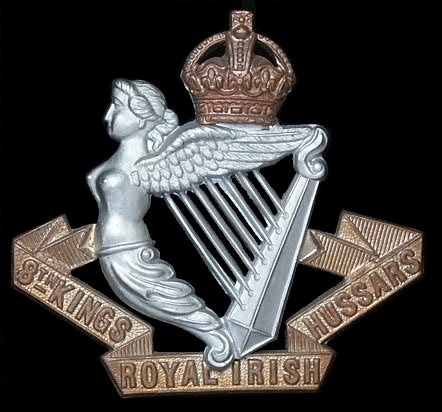
Cap Badge - 8th King's Irish Hussars
Status
Material
White Metal / Copper
Provenance
Location
Origin
Caption
Date
Status Date
Note
Dimension Notes
Condition Notes
FEATURE INFO
Artifact Type
Object
Objet
Category
History
Histoire
Collection
BADGES
BADGES
Cap Badge - 8th King's Royal Irish Hussars
Cap Badge - 8th King's Royal Irish Hussars
This badge was sold by Jim Purdy for $40.00 on e-Bay in the Spring/Summer of 2017. This badge was deemed irrelevant to the museum. The money was used to purchase relevant badges for the collection.
The 8th King's Royal Irish Hussars was a cavalry regiment in the British Army, first raised in 1693. It saw service for three centuries, before being amalgamated into The Queen's Royal Irish Hussars in 1958.
The regiment was first raised in Ireland as Henry Conyngham's Regiment of Dragoons in Londonderry in 1693, and ranked as the 8th Dragoons. It was briefly disbanded from 1714 to 1715, and 1716 to 1719, reforming each time without any loss of precedence. In 1751, it was formally titled as the 8th Regiment of Dragoons, and designated light dragoons in 1775 as the 8th Regiment of Light Dragoons.
The regiment was renamed in 1777 for George III as the 8th (The King's Royal Irish) Regiment of (Light) Dragoons, and became hussars in 1822, as the 8th (The King's Royal Irish) Regiment of (Light) Dragoons (Hussars). The title was simplified in 1861 to the 8th (The King's Royal Irish) Hussars. After service in the First World War, the regiment retitled as the 8th King's Royal Irish Hussars in 1921, and was transferred to the Royal Armoured Corps in 1939. Fighting with distinction in North Africa, Greece, France & Germany during the Second World War. The regiment survived the immediate post-war reduction in forces, and went on to distinguish itself in the battles of the Korean War, but was recommended for amalgamation in the 1957 Defence White Paper prepared by Duncan Sandys. The regiment was amalgamated with the 4th Queen's Own Hussars, to form The Queen's Royal Irish Hussars the following year.

bottom of page