top of page

dimension
Length, in
0
Length, ft
0
Length, cm
0
Height, in
0
Height, cm
0
Height, ft
0
Weight, g
0
Weight, oz
0
Weight, lb
0
Detail Info
Object ID
1998.132.058
Access Number
1998.132
Subjects
Object Name
Badge, Cap
Other Name
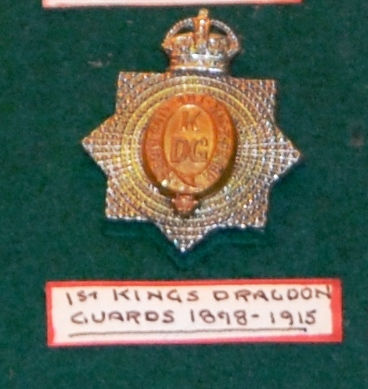
Cap Badge - 1st Kings Dragoon Guards
Status
Material
Bi-Metal
Provenance
Location
Origin
Caption
Date
Status Date
Note
Dimension Notes
Condition Notes
FEATURE INFO
Artifact Type
Object
Objet
Category
History
Histoire
Collection
BADGES
BADGES
Cap Badge - 1st Kings Dragoon Guards, 1898 to 1915
Cap Badge - 1st Kings Dragoon Guards, 1915 to 1937
The 1st King's Dragoon Guards was a cavalry regiment in the British Army. The regiment was formed in 1685 as The Queen's Regiment of Horse, named in honour of Queen Mary, consort of King James II. It was renamed The King's Own Regiment of Horse in 1714 in honour of George I. The regiment attained the title 1st King's Dragoon Guards in 1751. The regiment served as horse cavalry until 1937 when it was mechanised with light tanks. The regiment became part of the Royal Armoured Corps in 1939. The regiment merged with The Queen's Bays (2nd Dragoon Guards) in 1959 to form 1st The Queen's Dragoon Guards.
At the start of WW I the KDG were in India as part of the Lucknow Cavalry Brigade, 1st Indian Cavalry Division, still wearing the Eagle. The Colonel of the Regiment requested and was granted permission to change the badge (as the Austrian Imperial Eagle was thought of as an enemy insignia) and the new Bi-metal Star and Garter badge was born on 13 April 1915 when the design based on the long held Regtimental Cypher and closely resembling the pattern on the Regimental button was lodged in the Pattern Room. Sealed Pattern No 8381/1915.
In fact though,some members of the KDG were wearing Eagle badges right up till 1916 (alongside some wearing the Star & Garter badge) because of war supply shortages. There was also a GM version issued in 1916 to speed up production (the BM version taking longer to produce). Sealed Pattern No 8381a/1916 and it was this badge (over 2000 were ordered - all with sliders) which was the predominant (if not the only) badge worn through WW I.
NCOs of the KDG wore no Arm badge during WW I and it only reappeared when they had returned to India and 'settled down' after the rigours of the trenches. The KDG wore the BM badge in India/Iraq/Afghanistan during 1919 and the early 1920's. It is almost certain that the badge was locally manufactured in India or Iraq and was of a 'cast' construction with loops.
Hitherto, the die struck badges, produced in UK had a slider fixing and was unsuitable as an arm badge. A number of slider fixing badges were sent to a manufacturer in 1935 and fitted with loops but these were unlikely to have been used as arm badges as the Regiment had already adopted the Crowned Monogram arm badge 1930/1931 which they wore right up to 1959.
Therefore, no Arm Badges were worn after withdrawal of the eagle until well after the end of WW I. First badges produced in theater of Ops India/Iraq and of cast construction. Only badges 'officially' produced with loops well after use of Cap Badge as Arm badge had ceased. Therefore any Die Struck BM badge with loops is either the one produced officially but actually used in the Field Service Cap or locally modified by NCOs themselves to save a bit of cash!

bottom of page