top of page

dimension
Length, in
0
Length, ft
0
Length, cm
0
Height, in
0
Height, cm
0
Height, ft
0
Weight, g
0
Weight, oz
0
Weight, lb
0
Detail Info
Object ID
1998.133.035
Access Number
1998.133
Subjects
Object Name
Badge, Cap
Other Name
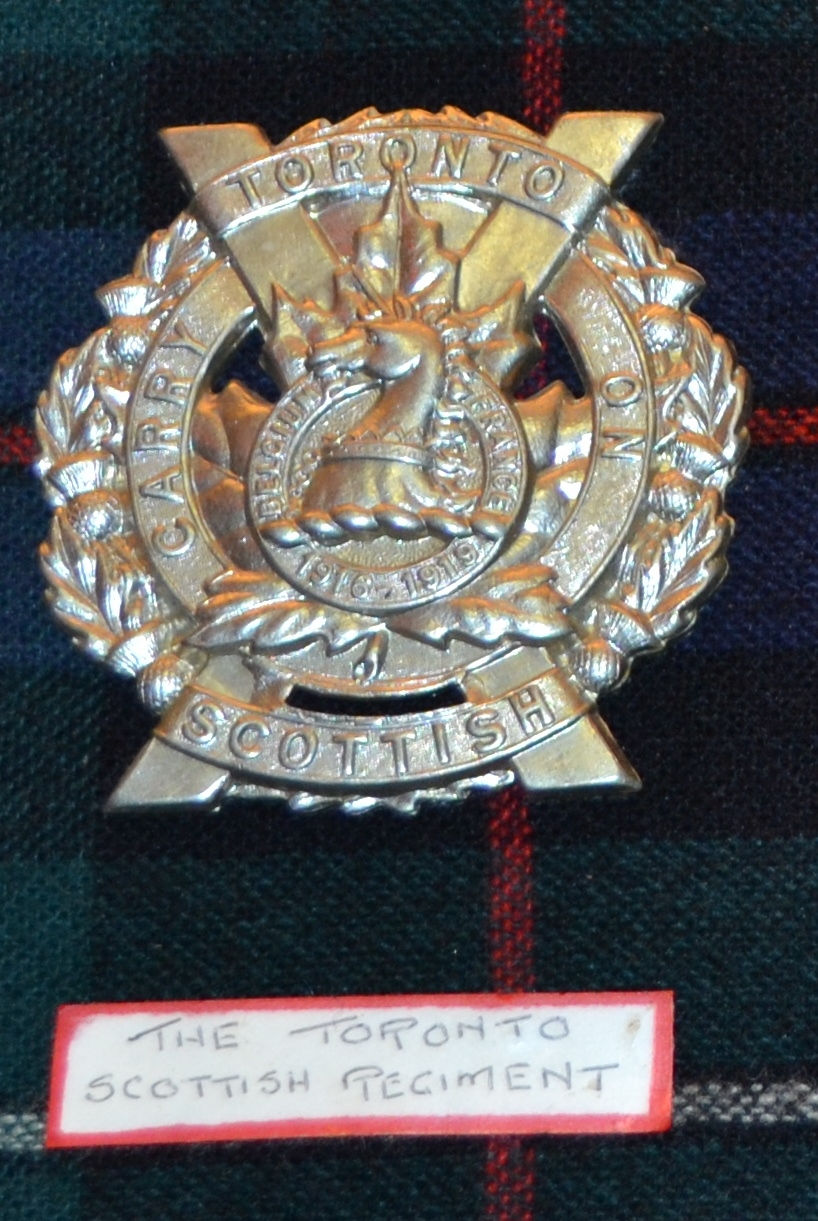
Cap Badge - The Toronto Scottish Regt
Status
Material
White Metal
Provenance
Location
Origin
Caption
Date
Status Date
Note
Dimension Notes
Condition Notes
FEATURE INFO
Artifact Type
Object
Objet
Category
History
Histoire
Collection
BADGES
BADGES
Cap Badge - The Toronto Scottish Regiment
Cap Badge - The Toronto Scottish Regiment
Badge: On a wreath of thistles, the Cross of St. Andrew, charged in the centre with a maple leaf, both interfacing an annulus inscribed with the motto CARRY ON; upon a second annulus placed on the centre of the maple leaf and inscribed BELGIUM FRANCE 1916-1919, a unicom's head couped and gorged with an antique crown chained, and resting on an heraldic wreath; on the upper and lower bends of the wreath and resting on the arms of the Cross two scrolls, the upper inscribed TORONTO and the lower SCOTTISH.
Symbolism: The maple leaf represents service to Canada. The thistles (the national flower of Scotland) and the cross of St. Andrew (the patron saint of Scotland) are common devices among badges of highland infantry, and the overall shape of the badge is similar to The London Scottish, the regiment's first allied regiment. The unicorn is taken from the badges of the 75th "Overseas" Battalion and The Mississauga Horse in recognition of the regiment's historical connection with these units. The words "BELGIUM", "FRANCE" and the dates "1916-1919" commemorate the service of the regiment's perpetuated units during the First World War. "TORONTO SCOTTISH" is a form of the regimental title and "CARRY ON" is the motto of the regiment.
The Toronto Scottish Regiment, in the beginning, was known as the 75th Battalion. It was raised in 1915 when Lt.Col S.G. Beckett, undertook an assignment to recruit a battalion for the Canadian Expeditionary Force. Authority was granted to the 75th Battalion on 1 September 1915.
The Battalion served in France and Belgium during the Great War, winning a total of 18 Battle Honours. Upon their arrival home in Canada in June 1919, the 75th Battalion was disbanded.
After the Great War the Battalion was organized as the Mississauga Regiment, but on 1 September, 1921, they were designated the Toronto Scottish Regiment.
On 3 September 1939, the Canadian Government ordered the mobilization of units. Immediately upon this order, the Toronto Scottish Regiment set about recruiting, and formed a full-strength machine gun unit.
The Regiment sailed from Halifax in early December 1939, to Gourock, Scotland. They were the first complete unit to land in the United Kingdom during the Second World War. The Toronto Scottish were also the first Canadian unit to be granted the honour and privilege of mounting King's Guards at Buckingham Palace.
Throughout 1941, the Toronto Scottish Regiment engaged in intensive, specialized training, preparing for what would become known as one of the most dismal and costly fights in the War: the Dieppe Raid, 19 August 1942.
Only a handful of soldiers from the Regiment actually made it onto the pebble covered beach at Dieppe. The main body of the Regiment was ordered to remain 1,000 metres offshore until the first thrusts of men could clear a way for them on the beach. They however, could not make a landing on the beach, for the tide was turning. The anti-aircraft gunners of the landing barges, however, were able to keep heavy covering fire above their fellow soldiers on the shore while also hitting German aircraft above with intensive fire. The end result showed that the Toronto Scottish Regiment had only suffered one fatal casualty in the Dieppe Raid.
Until the end of the war in 1945, the Toronto Scottish Regiment fought under many commands in various countries while supporting several units. In 1945, when the war had finally come to an end, the Regiment had earned a total of 21 Battle Honours, one of which was awarded for bravery in the Dieppe Raid. The Regiment returned home to Canada in October of 1945 and it was disbanded on 31 December.

bottom of page