top of page

dimension
Length, in
Length, ft
Length, cm
Height, in
Height, cm
Height, ft
Weight, g
Weight, oz
Weight, lb
Detail Info
Object ID
2007.313.001
Access Number
2007.313
Subjects
Object Name
Photograph, Black & White
Other Name
Status
Material
Provenance
Location
Origin
Caption
Date
Status Date
Note
Dimension Notes
Condition Notes
FEATURE INFO
Artifact Type
Image
Image
Category
Collection
CANADA, 1960 - 1969
CANADA, 1960 - 1969
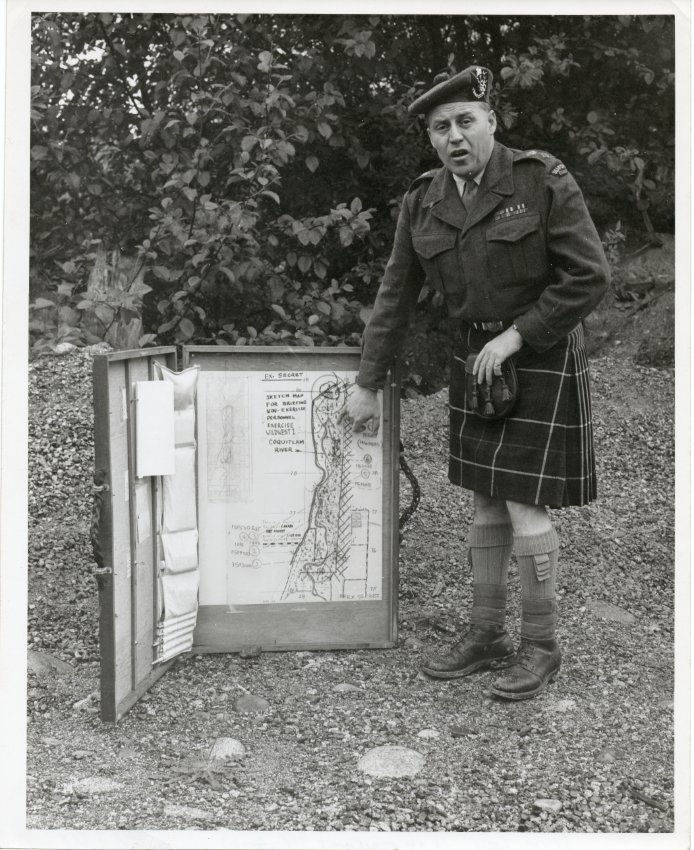
Lt Col Campbell briefing for Exercise Wild West I in Coquitlam, BC,1966
Lieutenant Colonel C. Bruce Campbell with battle board briefing for Exercise "Wild West I" on the Coquitlam River, Coquitlam, BC, circa 1966. He is wearing a battledress jacket, kilt, balmoral (TOS) and leather sporran.
The Map case shown is SHCMA artifact 1988.004.001.
From the regimental history, page 465:
"Training tended to be more adventurous in mid-1960s, perhaps as a result of the decreasing emphasis on national survival training. On several occasions Lt-Col. C. B. Campbell took the Seaforths out into rather rugged country. The long march down Indian River from Squamish to Wigwam Inn was one noted example as was the crossing of the Garibaldi Glacier. Another interesting weekend scheme was Exercise "Wild west". This was an exercise designed to
train the men in platoon tactics in a closed-in area against a guerilla force. An interesting aspect was that 65 men from the 56th Rifle Company, United States Marine Corps (Reserve), joined with the Seaforths in this exercise just as the Seaforths had trained with them earlier up on the snow level of Mount Hood. The friendly relations with the American troops over the border, which originated in the 1930s, was still going strong in the 1960s. Mention must be
made during this period of the excellent co-operation the Seaforths received from the Regular Army. To mount an exercise such as "Wild west", for example, called for a great deal of planning, and when it came to the question of such things as maps, special equipment,
provisions, and other necessities which were not available normally to a reserve unit, an appeal had to be made to the Regular Force. Time and again the Seaforths benefited from the latter, and a close relationship between the two forces permitted the Seaforths to broaden their experience and, at the same time, make their training more realistic and challenging."
Lt-Col. Campbell had served with the Rifle Brigade during the war. During his command (1963-1966) he stressed realism in training and brought the unit to a high level of efficiency at a time when the Suttie Commission was asking to cut back on all reserve regiments in Canada.

bottom of page