top of page

dimension
Length, in
0
Length, ft
0
Length, cm
0
Height, in
0
Height, cm
0
Height, ft
0
Weight, g
0
Weight, oz
0
Weight, lb
0
Detail Info
Object ID
2009.008.004
Access Number
2009.008
Subjects
Object Name
Apron, Kilt
Other Name
Kilt Apron - 1st Contingent, 1939
Status
Material
Canvas
Provenance
Location
Origin
Caption
Date
Status Date
Note
Dimension Notes
Condition Notes
FEATURE INFO
Artifact Type
Object
Objet
Category
History
Histoire
Collection
MOBILIZATION & DEPLOYMENT, 1939
MOBILISATION ET DÉPLOIEMENT, 1939
Kilt Apron - 1st Contingent, 1939
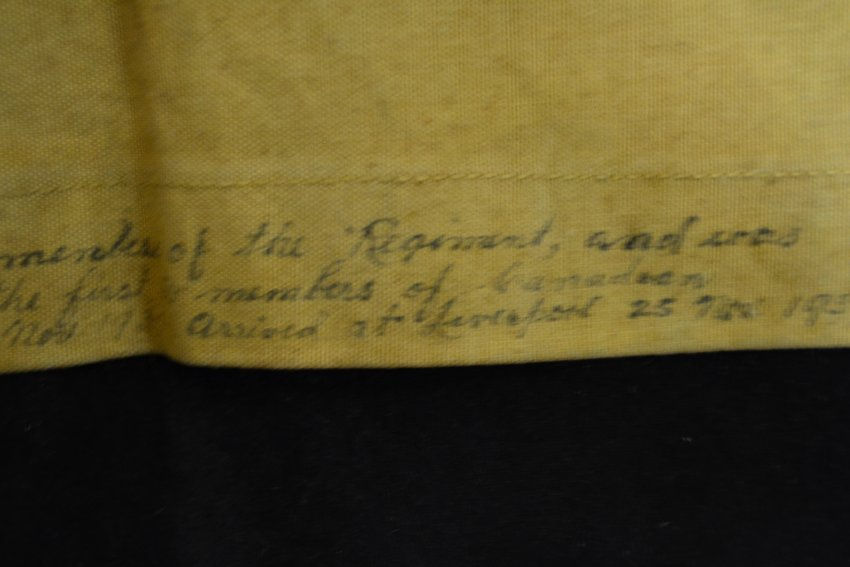
Kilt apron decorated 2nd Infantry Brigade battledress of the 1st Canadian Division, 1939 "This kilt apron was one of the only four taken to England by members of the Regiment and was the property of K52533 P.S.M. Vance, E. H. who was one of the first 50 members of Canadian Infantrymen to land in England. He left Vancouver on 11 November 1939. He sailed on 17 November 1939. P.S.M. Vance arrived at Liverpool on 25 November 1939." Sergeant E. Biddlecombe; Sergeant H. E. (?) McNutt; Lieutenant H.P. Bell-Irving, Mrs. H.P. Bell-Irving and P.S.M. (WO III) E.H. Vance.
NOTE: Platoon Sergeant Major (PSM) was an appointment in the British Army in the short-lived rank of warrant officer class III (WO III), created in 1938. The platoon sergeant major, and his cavalry counterpart, the troop sergeant major, were part of an experiment in giving experienced non-commissioned officers command of units formerly reserved for commissioned officers (platoons and troops). The experiment was not considered a success, and no promotions were made to the rank after 1940: most existing WO IIIs were commissioned as lieutenants.
Kilt Aprons (covers) were worn by Highland regiments on active service. Not only did the apron protect the kilt but it also made the kilt less conspicous in the field. It is a brown canvas apron with tape tie in a seam at the top, a single button flap pocket in the centre (actng as a sporran).



bottom of page