A Patron's Visit to Coriano Ridge War Cemetery
In June this year, my wife, Maureen and, I embarked on a trip to Northern Italy to indulge in the many delights of that country and its people. Our principal focus was on the Adriatic towns of Rimini and Riccione, well-known beach holiday destinations for both local and international visitors. However, the beach was not at all our target - for we had arranged to spend a week at The Hotel Belvedere - a "bike hotel" in Riccione - from whence each day we would cycle to different countryside villages and towns and enjoy the bucolic surroundings and almost fairytale scenery, which abounds everywhere after one escapes from the coastal strip. Our redoubtable guide on most days was a rugged British ex-pat named Denis Shelvey, who, upon learning of our Canadian origin, made a point to mention that on one of our excursions we would be passing a Commonwealth Graves War Cemetery, the burial place of many Canadian soldiers.
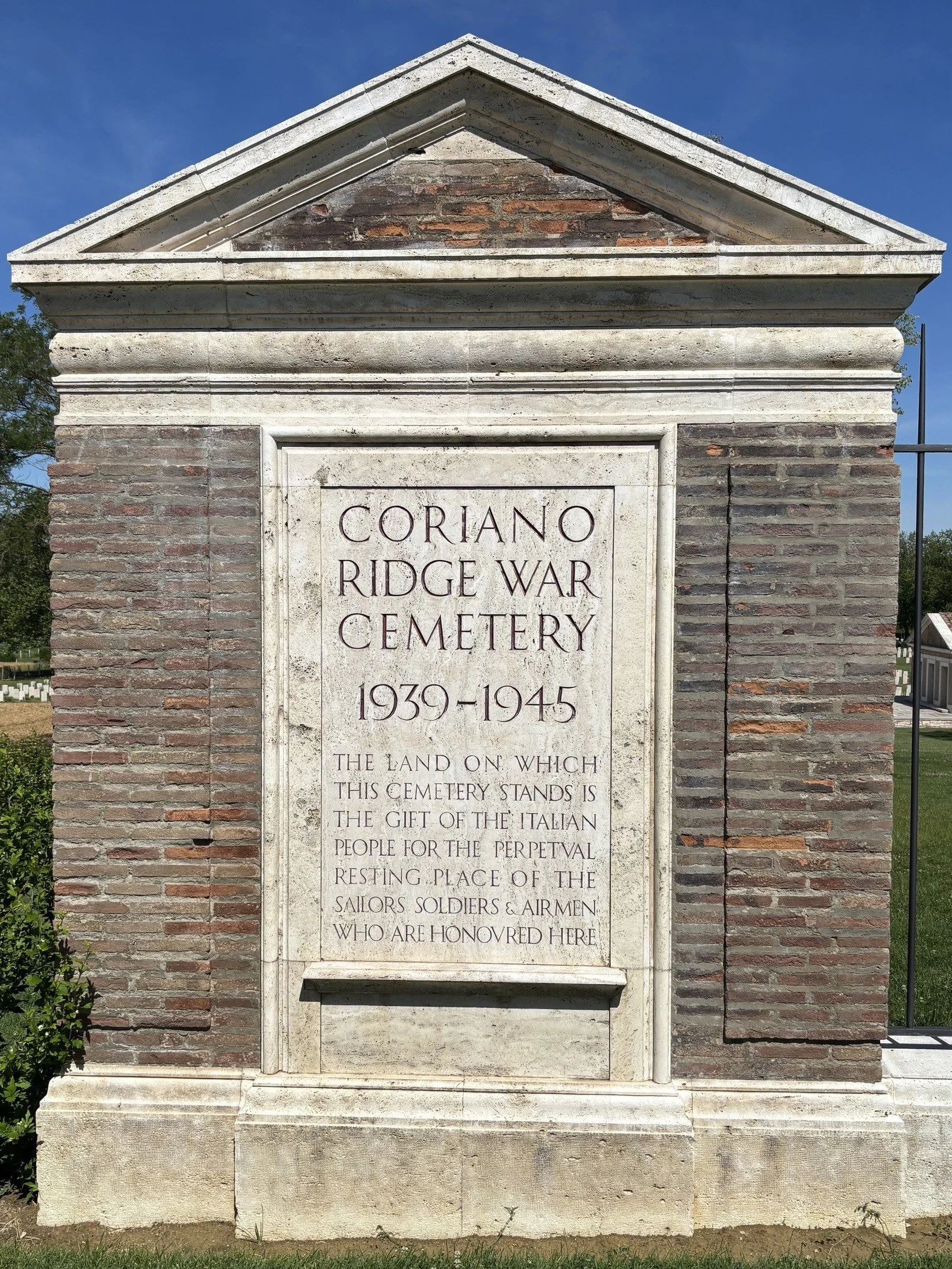
And thus, not having participated in our own Seaforths 2023 Italy Battlefield Tour, we had the good fortune to find ourselves, after cycling from sea level up into the hills above Riccione, at the Coriano Ridge War Cemetery, the last resting place of almost 2,000 allied soldiers, who had fallen in battle between August and October, 1944 in the great offensive to breach the Gothic Line and drive northwards. Of those who lie here in peace in this beautiful former olive grove, 427 were Canadians from the I Canadian Corps and 126 of these men were soldiers of the Seaforth Highlanders of Canada - the regiment of which I am honoured to be a member of the Patrons Corps.
It was both a memorable and a humbling experience, as it is to all Canadians who are able to visit, to lose ourselves in solemn contemplation, walking amidst row after row of the white headstones of those largely very young men who had voluntarily left the safe haven of Canada, only to be killed in a foreign place such as Sicily, Ortona or Coriano so far from their homes and families to which they would never return. Here, they lie in a wonderful place between the ocean and the idyllic hills and villages - so hard fought over - San Clemente, Saludecio, Montefiore, San Martino, San Lorenzo and San Fortunato - and the craggy ramparts of the tiny nation state of San Marino.
It was not possible for us, somewhat irreverently dressed in our cycling togs, to visit and bow our heads in silence before each individual Seaforth grave at Coriano Ridge, but we did seek out and pay special homage to that of Captain Kenneth Gilbert McBride of Nelson, BC, because of the poignant story behind his death at the age of 24, when his tank carrier vehicle struck a German mine.
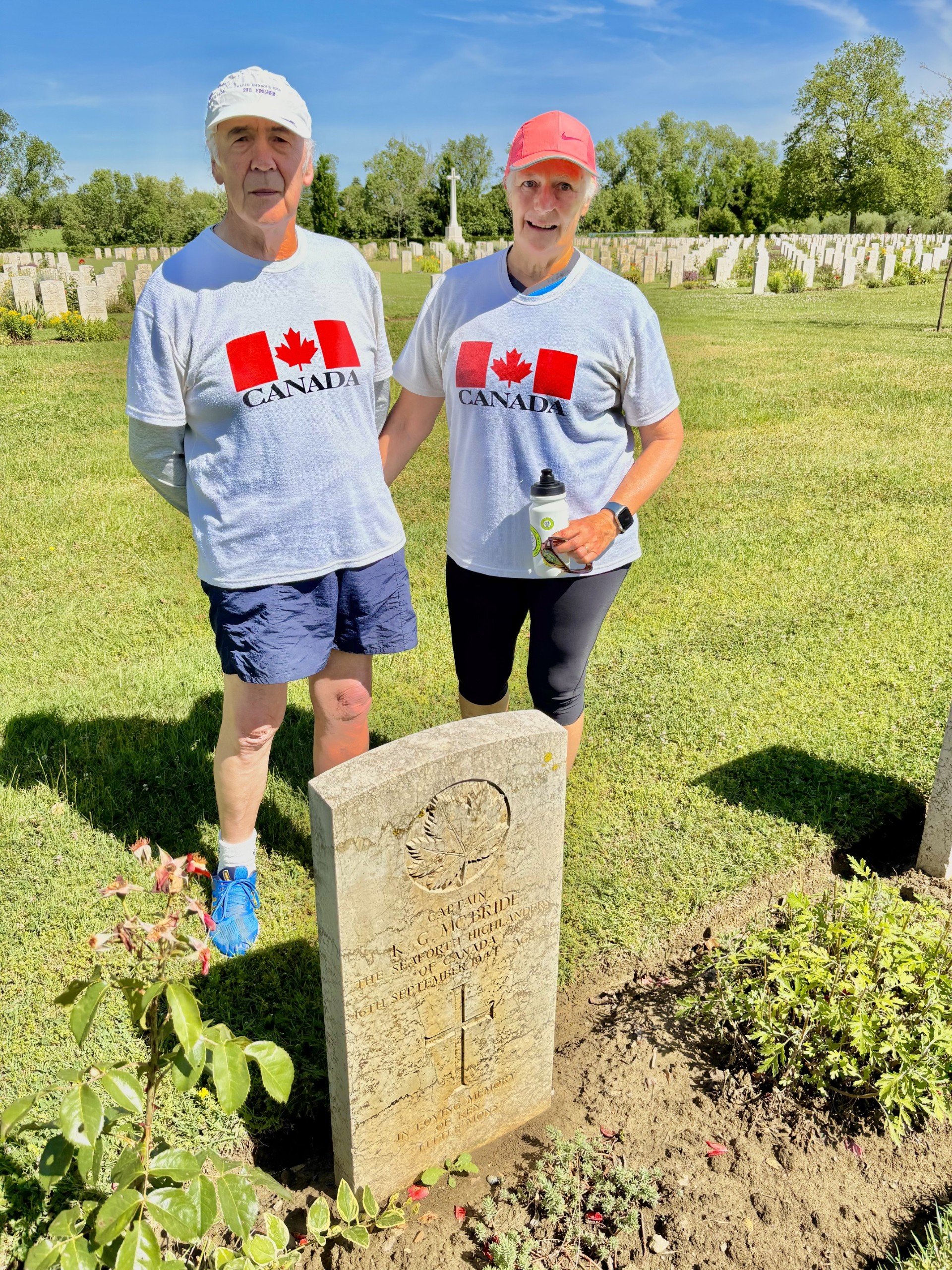
At Captain McBride's grave 2026
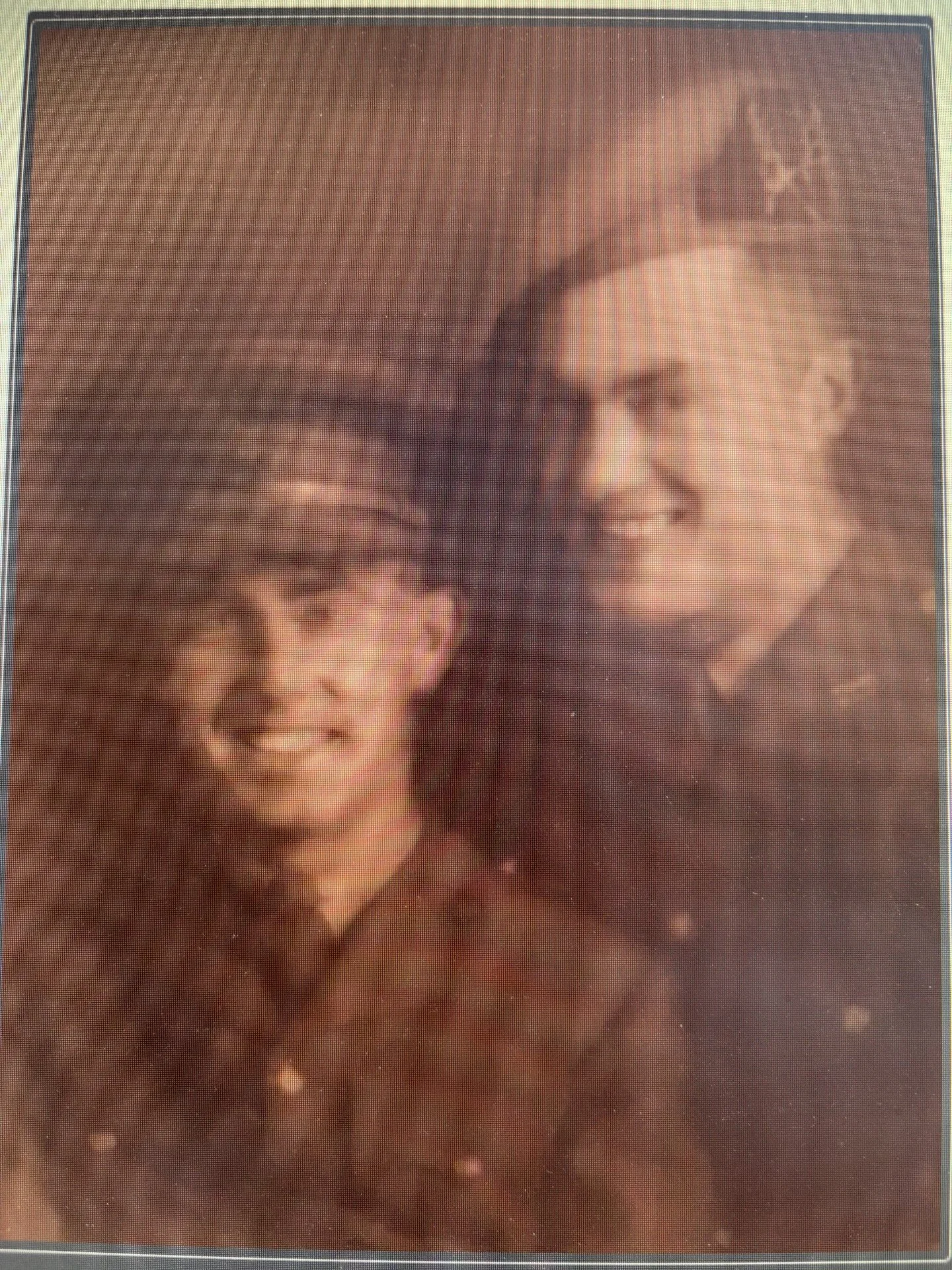
Leigh and Kenneth McBride
Captain McBride and his elder brother, Major Leigh McBride, aged 27, both served in the Seaforths in the Sicily campaign, in which Leigh suffered a bullet wound in his shoulder. They were in the thick of it together through Ortona and separately participated in the celebrated Christmas Dinner of 1943. Kenneth described his experience in Ortona as "Stalingrad No. 2". However, during the Liri River campaign of May, 1944, Leigh's 4 man unit was heavily shelled by German artillery. He was the the sole survivor and was very seriously wounded with arm and leg injuries and the loss of his right eye. Unknown to the regiment, which declared him to be Missing in Action, he was taken prisoner, and properly cared for in accordance with the protocols of the Geneva Convention. He was eventually transferred to Oflag 7B, a prisoner of war camp in Germany.
On September 16, 1944, while Leigh was at the Oflag 7B prison camp, Kenneth and three other soldiers were killed near Rimini, when their carrier vehicle ran over a road mine.
The tragedy of the brothers' story is magnified by the fact that it was only on September 20, 1944 that their parents in Nelson, BC received the joyful news that Leigh, who had now been missing for four months, was alive and in a POW camp. They were still rejoicing these glad tidings when only two days later they received the dreaded telegram advising them that their other son, Kenneth, had been killed in action six days earlier.
After the hostilities, Leigh did not participate to any great extent in commemoration events - until the 1975 Canadian Forces Tour on the 30th Anniversary of Italy's liberation, at which time he visited his brother Kenneth's grave at Coriano Ridge for the first and only occasion.
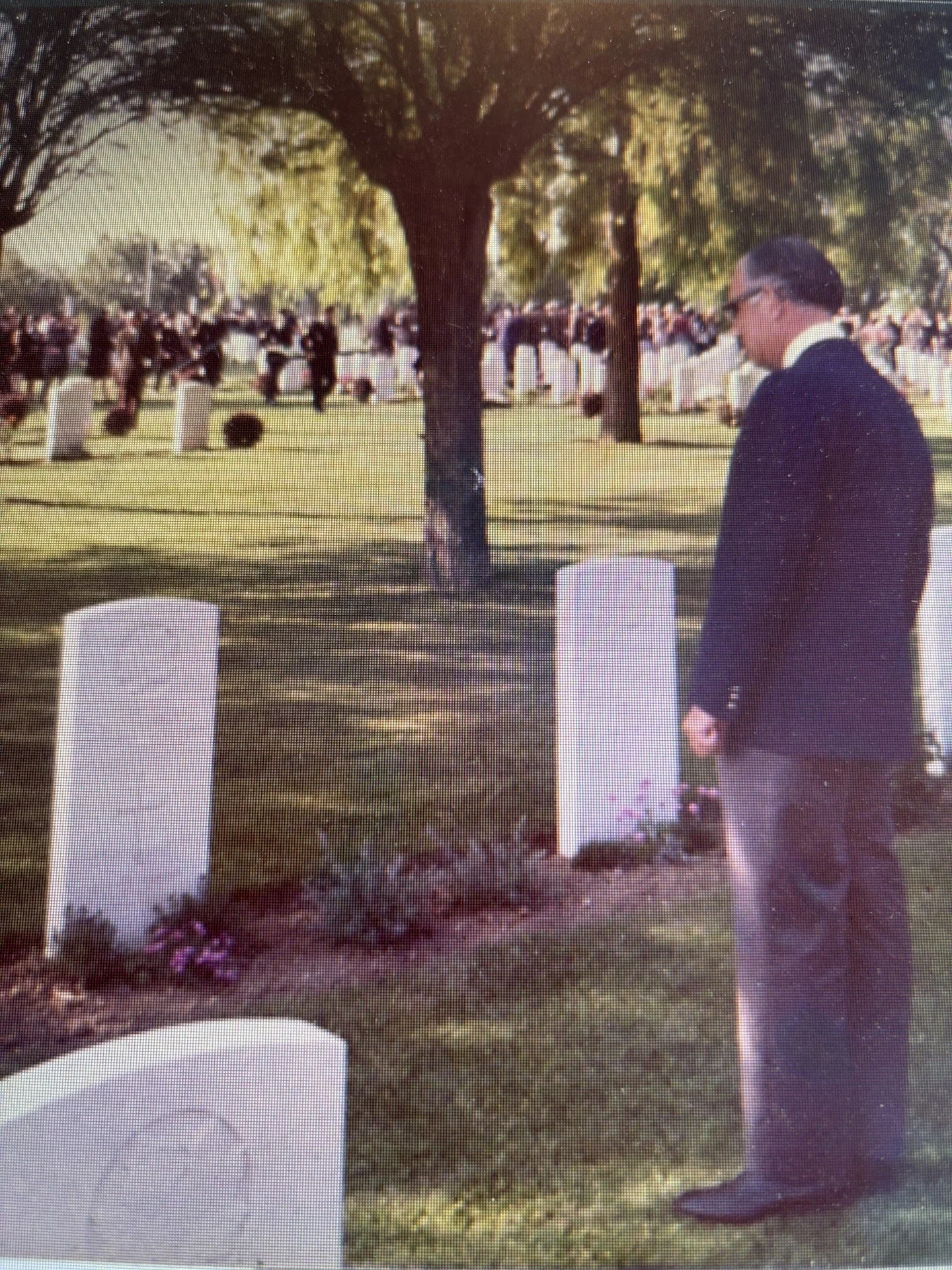
Leigh at Kenneth's grave, 1975
At the foot of Kenneth's headstone are engraved the apparently enigmatic words "Little Mons". When his father and Kenneth corresponded during the war, they used the nicknames of "Old Mons" and "Little Mons" respectively. His parents were allowed to add some short words to his headstone - and they chose "Little Mons".
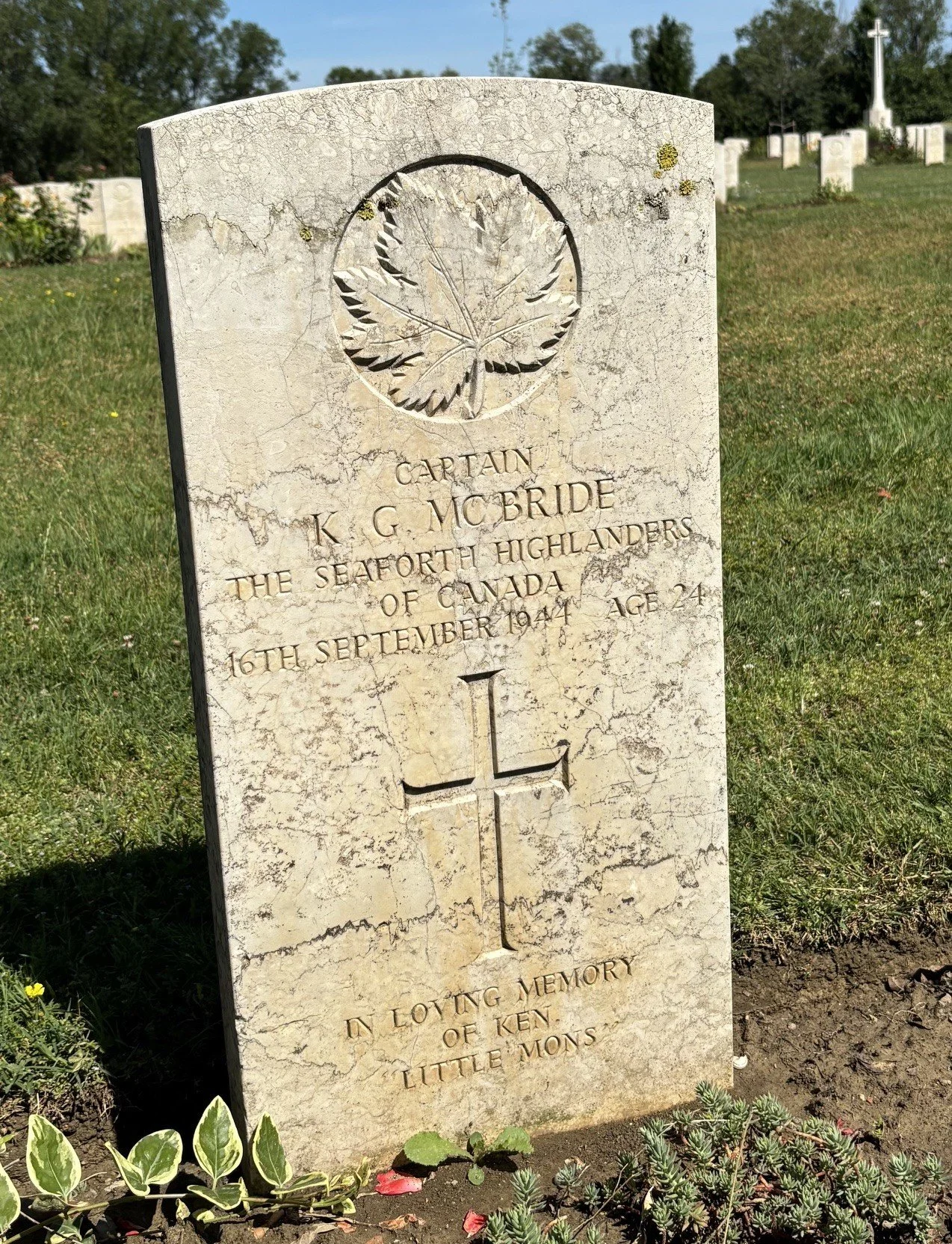
Gravestone of Captain McBride
The scale of the Rimini Campaign was staggering. In a period of less than 40 days, approximately 10,000 allied and axis combatants were killed. It is estimated that one and a half million artillery, aerial or naval bombs or shells were expended. Eighty two per cent of the buildings of Rimini were destroyed, although its celebrated Arch of Augustus and Bridge of Tiberius miraculously survived. The Seaforths performed magnificently throughout - we would be remiss not make specific reference to Private Smokey Smith's VC so gallantly earned at the Savio River on October 21/22, 1944 - and there is surely a heartbreaking story for each of those who lie buried at Coriano Ridge.
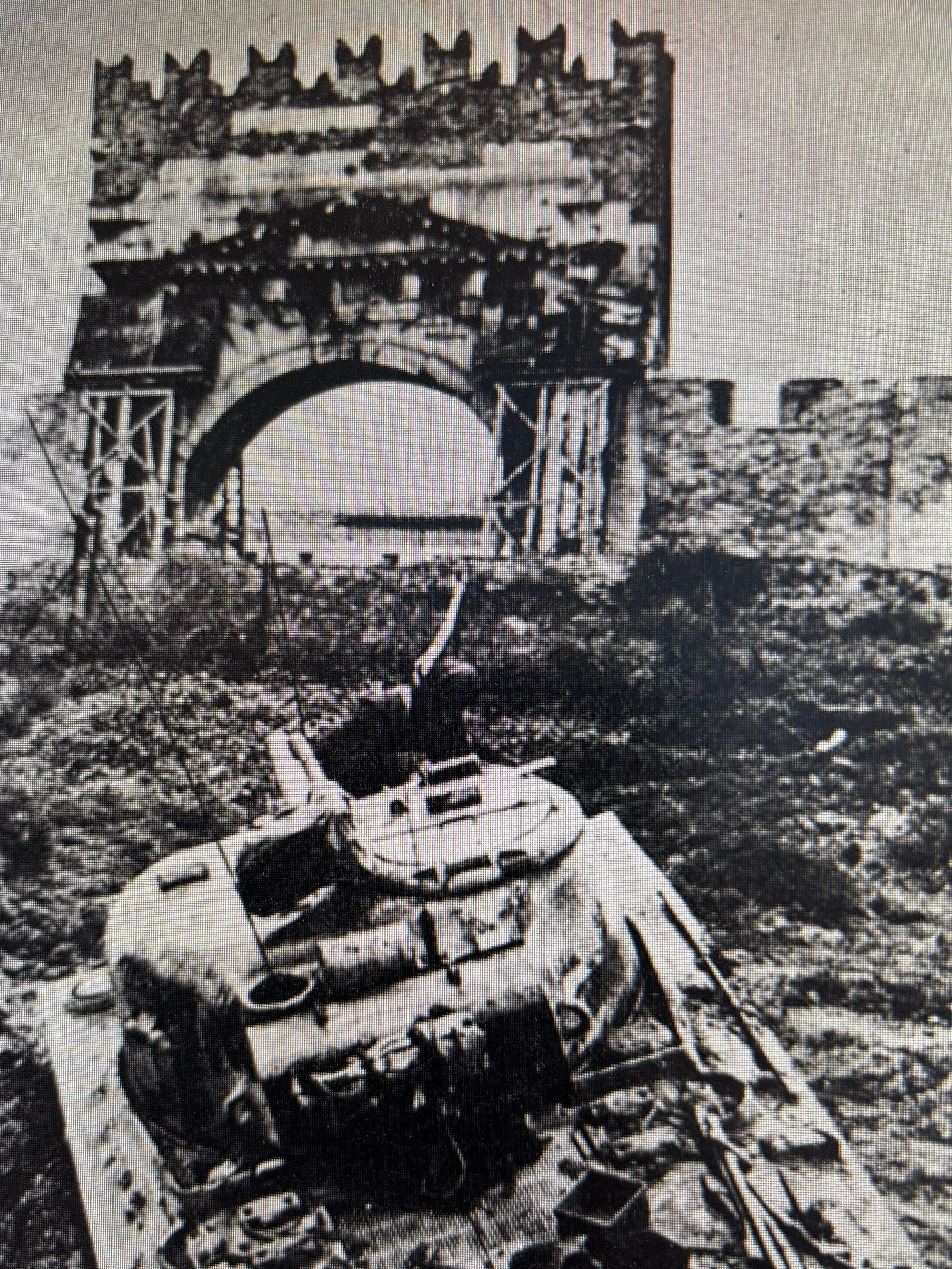
Arch of Augustus, October 1944
If you have an opportunity to visit Coriano Ridge, please take it.
David Lunny,
Member, Patrons Corps of the Seaforth Highlanders of Canada